A toggle clamp that gives way where the designer chooses
The clamp
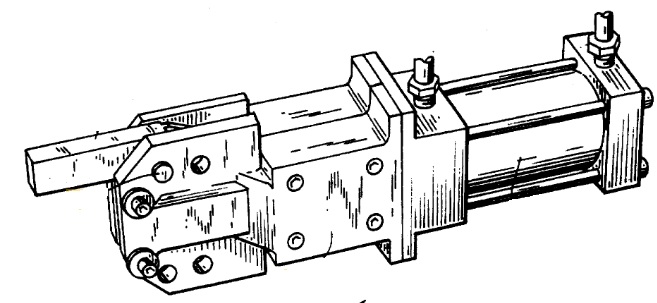
A pneumatic toggle clamp holds a part on a machining fixture. The cylinder on the right pushes a yoke; a link joins the yoke to the rear end of the clamp arm, which turns about its pivot and comes down on the part.
Contact
The arm lands on the part and stops. The yoke keeps moving. From here on the link can only follow if its two pins come closer together.
The dead centre
When the link stands square to the yoke's travel, its pins are at their closest. Something has to give way here, by a fraction of a millimetre. In this clamp it is the link itself: a C-shaped spring, which bends.
Locked
Just past the dead centre the yoke reaches its stop. The bent link now pushes the yoke against the stop instead of back toward the cylinder.
No air
Cut the air supply: nothing moves. The part stays clamped, held by the bending of the link. This is why toggle clamps are used where a lost air line must not drop a part.
A thinner part
Plate from the mill varies in thickness from piece to piece. On a thinner piece, with the same setting, the arm comes down further and the link bends a little less. The clamp still locks, and still presses hard enough to resist the cut. No adjustment.
With a rigid link
Now the conventional clamp: a solid link, set the same way. On the thicker piece only the steel of the clamp can give way, and the cylinder runs out of force before the dead centre. The part is held while the cylinder pushes, and released as soon as the pressure drops.
Forced past
A stronger cylinder pushes it over. Now the clamp marks the part and overloads its own pins. And the cylinder pulls back with less force than it pushes, because the rod takes part of the piston area: it may not be able to open the clamp again. The clamp is jammed closed.
Back to the spring link
With the spring link the force in the link stays moderate, and the cylinder pulls the yoke back over the dead centre. Past it, the link helps the opening. The clamp opens on command, on every piece.
Where it stops
The spring link has limits of its own. Too soft, and it bends past its elastic range and takes a permanent set. Too stiff, and the clamp jams again. And the force still rises with thickness, much less than before.
US 5,676,357 (Aladdin Engineering & Manufacturing, 1995) chose where the clamp gives way, and how much.
Other ways to lock on uneven parts
The same problem has been solved by putting the compliance, or the adaptation, in other places — before and after this idea, US 5,676,357 (1995).
Adjust by hand
Rigid link and an adjustable spindle, set for each batch of thickness.
Size the part first
A sliding wedge lets the arm find the part, then locks before the toggle closes.
A cam instead of a dead centre
A profiled cam keeps the clamping force nearly the same on every thickness.
Springs at the pivot, or in the links
C-shaped springs carry the arm pivot in slots; other embodiments of the same patent use C-shaped spring links in the linkage.
Elastic link with a stop
The link shortens along its axis, then slanted stops make the lock irreversible.
A stack of flat springs
A link of several flat spring sections side by side: large deflection, high force.
Springs between two arms
The hook arm stops on the part; the driving arm compresses exchangeable springs.
A preloaded spring behind the toggle
The toggle slides in a slot; a spring keeps it at or past the dead centre.
Compensation built in
Current pneumatic power clamps adapt to the sheet thickness within a few degrees of arm travel, without shims; how they do it is not disclosed.
Force set by the motor
Electric power clamps adapt to the part by themselves, with speed and torque set from the controller.