A bow that is easiest to hold when it is fully drawn
The simple bow
A bow stores in its limbs the work the archer does in drawing the string, and gives it back to the arrow at the release. In the simple bow, the longbow or the recurve, the string is tied to the limb tips.
Drawing it
As the archer draws, the limbs bend further and push back harder. The force on the string grows all the way to the end of the draw.
Aiming at the peak
The archer must hold the string still at full draw while aiming, and that is exactly where the force is highest. To store more energy the bow must draw harder, and the archer then has more to hold.
Pulleys at the tips
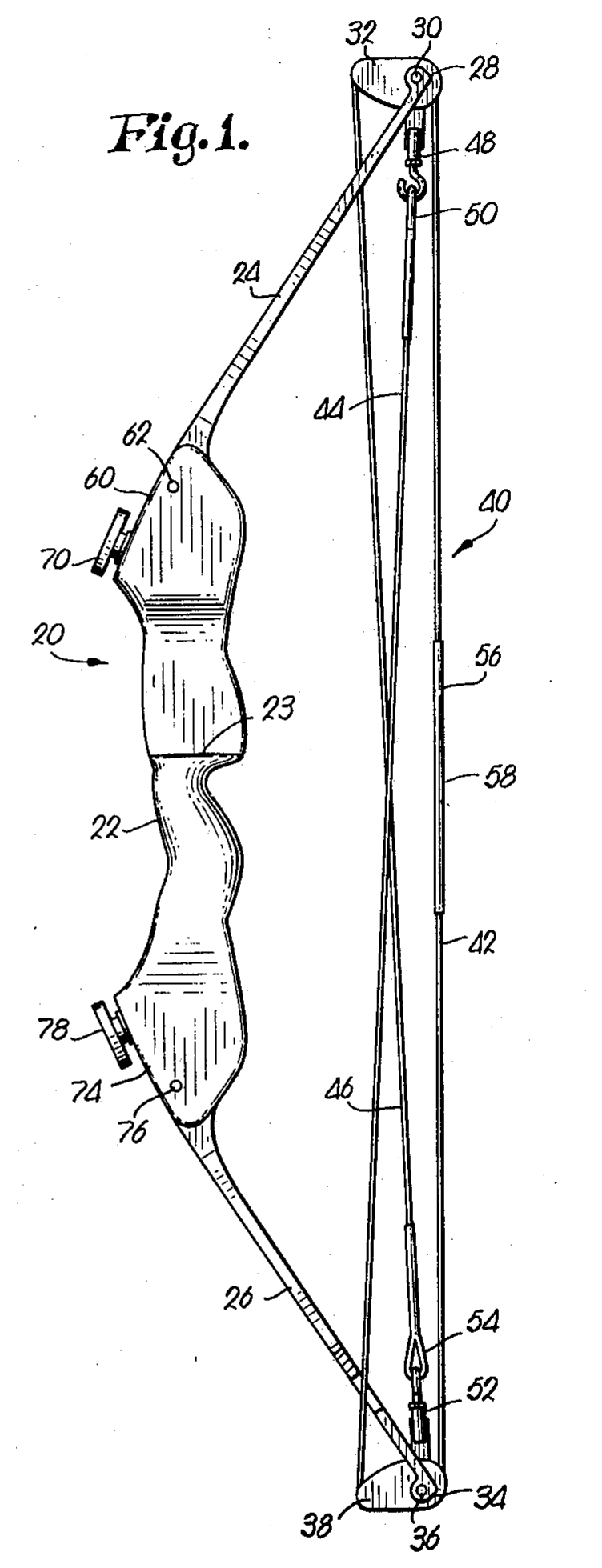
The patent puts a pulley at each limb tip, turning on an axle placed off its centre. The string runs from pulley to pulley; from each pulley a cable runs to the axle of the opposite limb.
Early in the draw
Pulling the string unwinds it and turns the pulleys, and the same rotation winds the cables. The string leaves the pulley close to the axle, the cable far from it: a little string winds a lot of cable, the limbs bend fast and the force climbs.
The peak
The limbs are bent further and pull harder, but each bit of draw now bends them less, because the axle is moving round the pulley. The force reaches its peak part-way through the draw.
Full draw: the valley
The pulley has turned about half a turn and the arms have exchanged: the string now leaves far from the axle, the cable close to it. The limbs pull harder than ever on the cables, but the pulley passes only a fraction of that to the string. The archer aims holding well under half the peak.
More energy, same peak
The area under each curve is the energy stored and given to the arrow. With the same peak and the same draw, the pulleys fill much more of it: the force rises early and stays high. The arrow leaves faster.
Same arrow, much less to hold
Ask instead for the same arrow speed. The simple bow then needs stiffer limbs to store the same energy, and its force keeps rising to a higher peak, which the archer must hold while aiming: nearly four times what the bow with pulleys asks.
Where it stops
No bow can store more than its peak held over the whole draw. More eccentric pulleys lower the holding force but also the energy. And the bow works for one draw length: it must be set for its archer.
US 3,486,495 (H. W. Allen, 1966) did not make the archer stronger. It changed where along the draw the bow asks for strength.
Other ways to shape the draw force
The force a bow asks of the archer along the draw has been shaped in other ways — before and after this idea, US 3,486,495 (1966).
The longbow and the recurve
The string tied to the limb tips: the force rises to the end of the draw, and the archer holds the peak while aiming.
Pulleys and elastic cords
A rigid frame with rollers at its ends and an endless cord with elastic tubes: the energy goes into rubber, and the force still grows to the end.
Limbs on pivots
Limbs set at different angles on the handle change the draw weight without new limbs; the shape of the force curve stays the same.
Two cams in one
Each cam joins a larger and a smaller element eccentrically about the axle: string and cable wind on different radii.
Separate tracks, adjustable
Lever cams with separate tracks for the string and the cables, adjustable to keep the two cams in step and to change the draw weight.
One cam
A single cam on one limb and a plain wheel on the other: there is no pair of cams to keep in step.
Cams slaved to each other
Each cam takes up one cable while letting out the other; the two cams move together and stay in time.
Binary cams in production
Cams linked to each other by a loop of string, fitted to production bows since the 2005 model year.
Let-off set in fine steps
Gear-driven draw modules and stops on the cam change draw length and let-off in fine steps, and the stops follow the module.