A derailleur that follows the sprockets
Changing gear means moving the chain from one sprocket to the next, and the rear derailleur does it with a small wheel hanging under the sprockets, the guide pulley. Everything depends on how far that wheel sits from the sprocket in use. In the derailleurs known in 1964 it moved sideways at a fixed height, so it was right for some sprockets and wrong for others. This patent's idea is to tilt its path so that it follows the sprockets: one setting, close to every one. The patent promises three things: quicker shifts, less resistance while shifting, and a chain equally taut on every sprocket.
If you set up your own bike, this is the gap you adjust with the B screw. And the idea does not come alone: what the patent claims is the tilted parallelogram together with one coil spring, which tensions the chain on every sprocket and steadies the cage, and with the cable that pulls the whole body obliquely downward. The tour follows the idea; the explorer lets you test it on packs from five to twelve speeds.
The rear derailleur
The chain runs from the chainring to one of five sprockets on the rear wheel. To change gear, a cage hanging below the sprockets moves sideways and takes the chain with it to the next sprocket. The upper wheel of the cage, the guide pulley, steers the chain.
Close under the sprocket
The guide pulley works best close under the sprocket the chain is on. The stretch of chain between them is then short, each sideways step of the cage tilts it sharply, and the chain is pushed onto the next sprocket at once. Far below, the stretch is long, a step barely tilts it, and the chain hesitates.
The known way
In the derailleurs of the time the pulley moves straight sideways, always at the same height. Set close under the largest sprocket, it ends up far below the smallest one.
No single setting
Set it close under the smallest sprocket instead, and on the way back the pulley runs into the largest. No setting suits the whole pack: this is the shortcoming of the earlier technology that the patent describes.
Tilt the path
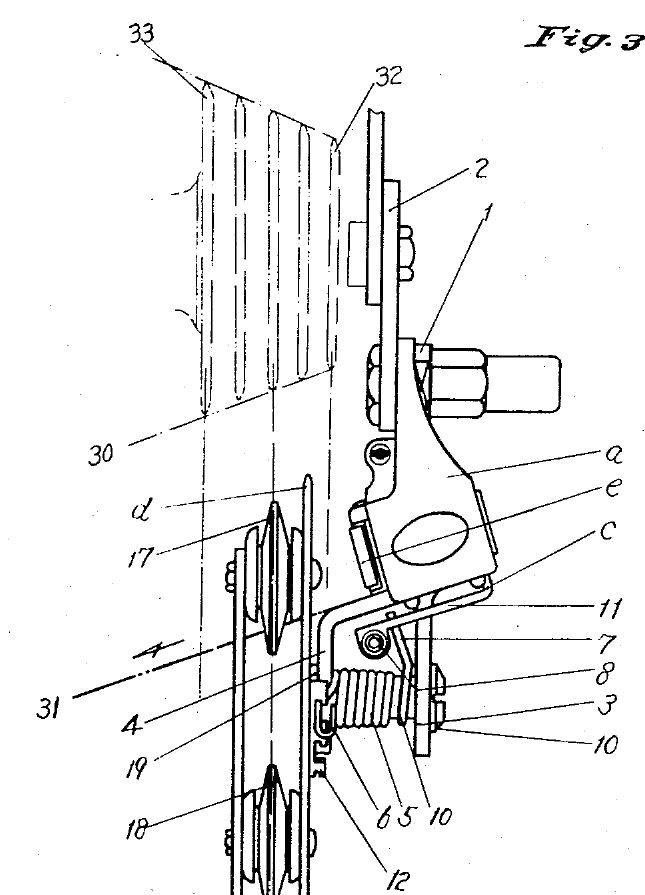
Maeda tilted the parallelogram that carries the pulley. Its path now runs parallel to the line through the lower edges of the sprockets, line 30 in the patent drawing: as the pulley moves out toward the small sprockets, it also rises.
One setting for the whole pack
Set once under the largest sprocket, the pulley now stays almost the same distance under every sprocket. Every step of the cage tilts a short stretch of chain, from the first gear to the last.
Where it stops
The lower edges of the sprockets lie on a straight line only roughly. On today's wide packs, from ten to fifty teeth, they bend into a curve: the tilted path fits the two ends, and in the middle the pulley falls away from the sprockets again.
US 3,364,762 (Tetsuo Maeda, 1964) made the guide pulley follow the sprockets instead of the wheel axle.
What the patent says was wrong with the earlier derailleurs
- The distance between the guide pulley and the sprockets is not fixed, so the chain cannot be moved quickly from one sprocket to the next.
- The chain engages the sprockets over very different lengths, so shifting meets great resistance.
- The chain tension differs greatly between the smallest and the largest sprocket: too weak and the chain may come off, too strong and it drags.
Other ways to keep the pulley close
Before 1964 the pulley was moved sideways by plungers and by straight parallelograms; after the patent the slanted path became the common way; today the widest packs keep the gap in other ways, and the cable has given way to wires.
A plunger and two cables
A cable pulls the guide pulley across the sprockets through a spring, and a second cable sets the chain tension.
A parallelogram, straight
Pulling the cable deforms the parallelogram and moves the chain across the sprockets; a spring in the lower pivot tensions it. The pulley keeps the same height under every sprocket.
The parallelogram for everyone
The first mass-produced deforming parallelogram rear derailleur, after Campagnolo's had made the design the high-end technology.
A helix and two cables
The French Cyclo kept making dual-cable derailleurs driven by a helix until the early 1960s: not a parallelogram.
The slant parallelogram
For twenty years SunTour's slanted derailleurs kept the upper pulley much closer to the sprockets than the others.
Indexed shifting
The patent expired in 1984; the next year Shimano launched indexed shifting, built on the slanted parallelogram.
Everyone else
By the end of the decade Campagnolo and the other makers had moved to the same design.
Straight again, with the pulley set back
For one-chainring mountain bikes SRAM moves the derailleur horizontally, against bumps; the upper pulley is set far back from the cage pivot and keeps the gap across the pack.
Wires instead of the cable
Electronic groups replace the shift cable with wires and house the electronics in the derailleur; patents for electric derailleurs of the articulated parallelogram type are still being granted.