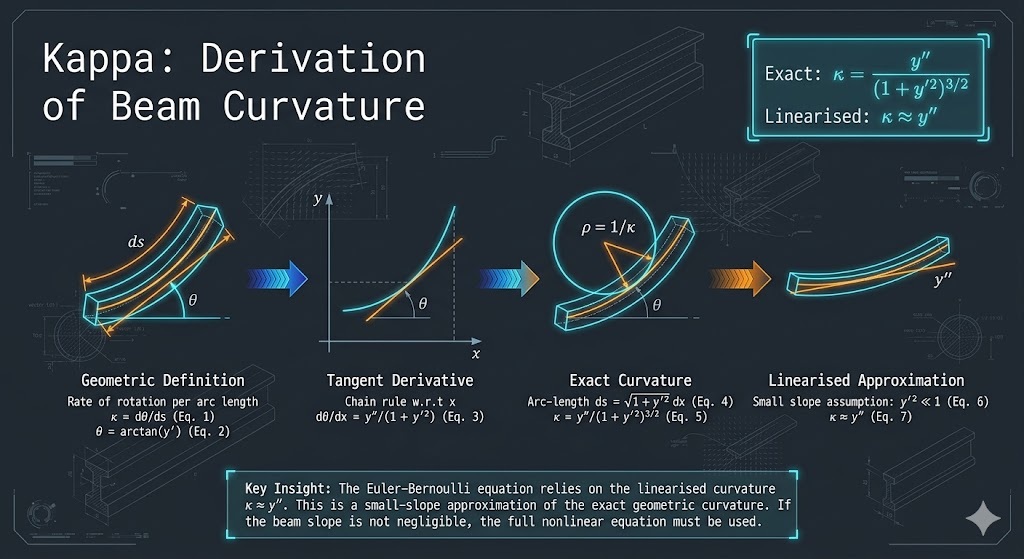
Curvature of a plane curve: \(\kappa = \dfrac{y''}{(1 + y'^2)^{3/2}}\)
A smooth curve \(y(x)\) lies in a plane. We want an expression for the curvature \(\kappa\) at a generic point, in terms of the derivatives of \(y\) , and then the conditions under which \(\kappa\) reduces to \(y''\) alone.
Coordinates: \(x\) horizontal, \(y\) vertical, \(y(x)\) single-valued and at least twice differentiable in the interval of interest.
At every point the tangent makes an angle \(\theta\) with the \(x\) -axis. The curvature is the rate at which \(\theta\) rotates per unit arc length:
This is a definition, not an approximation. It is equivalent to \(\kappa = 1/R\) , where \(R\) is the radius of the osculating circle. (1) holds for any smooth plane curve described by any parametrisation; what follows specialises it to the Cartesian form \(y(x)\) .
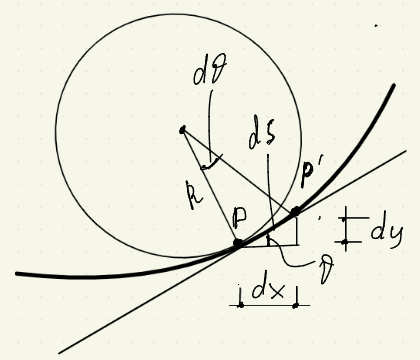
Since \(y(x)\) is single-valued, the tangent angle at any point is
where \(y' = dy/dx\) . (2) requires the curve to be expressible as a function of \(x\) — it fails at vertical tangents, where \(y' \to \pm\infty\) .
Differentiating (2) with respect to \(x\) by the chain rule:
The derivative of \(\arctan(u)\) is \(1/(1 + u^2)\) ; composed with \(u = y'\) , the numerator picks up \(dy'/dx = y''\) .
The arc-length element along \(y(x)\) satisfies
which is Pythagoras on the infinitesimal triangle \((dx, dy, ds)\) : \(ds^2 = dx^2 + dy^2 = (1 + y'^2) \, dx^2\) .
Now (1) can be rewritten as a ratio of rates with respect to \(x\) . Dividing (3) by \(ds/dx\) from (4):
The exponent \(3/2\) comes from the product of \((1 + y'^2)\) in the denominator of (3) and \((1 + y'^2)^{1/2}\) from (4). (5) is exact for any twice-differentiable single-valued curve \(y(x)\) . No approximation has been made; the only restriction is that \(y'\) must be finite (no vertical tangent).
The sign convention: with the axes oriented as above, \(\kappa > 0\) means the curve is concave upward (centre of curvature above the curve), \(\kappa < 0\) concave downward. This follows from the sign of \(y''\) .
When the slope of the curve is small — specifically, when
the term \((1 + y'^2)^{3/2}\) in the denominator of (5) tends to 1. The curvature becomes
To see how fast the approximation degrades: at \(y' = 0.1\) , the denominator is \((1.01)^{3/2} \approx 1.015\) — error below 2%. At \(y' = 0.3\) , the denominator is \((1.09)^{3/2} \approx 1.14\) — error around 13%. At \(y' = 1\) (45° slope), the denominator is \(2\sqrt{2} \approx 2.83\) — the linearised curvature overestimates the true value by a factor of nearly 3.
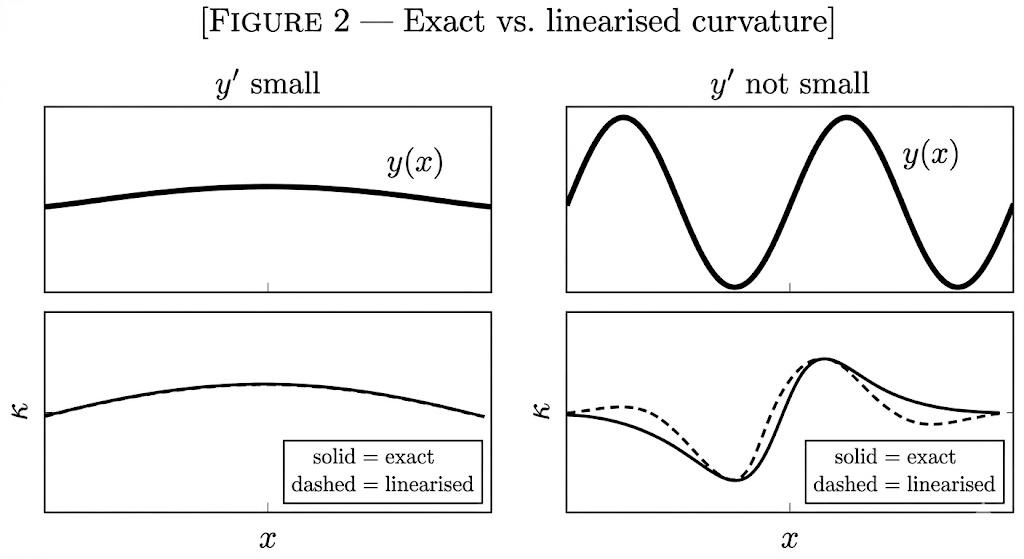
(7) is the curvature that enters the Euler–Bernoulli beam equation \(EI \cdot y'' = M(x)\) . Every derivation that starts from “curvature equals \(y''\) ” is using (7), not (5), and therefore carries the restriction (6): the beam slope must remain small everywhere along the span. For ordinary structural members this is satisfied by wide margins; for cables, arches, or post-buckled configurations it is not.
Exact curvature:
\[\boxed{\kappa = \frac{y''}{(1 + y'^2)^{3/2}}}\]
Linearised curvature (small slopes):
\[\boxed{\kappa \approx y''}\]
Definitions and restrictions, in the order they entered the pipeline: smooth curve \(y(x)\) with finite slope (2), geometric definition of curvature as \(d\theta/ds\) (1), Cartesian arc-length element (4), small-slope assumption \(y'^2 \ll 1\) (6). The exact formula (5) requires only the first three. The linearised formula (7) requires all four. If (6) fails, (7) is invalid but (5) still holds.
This is the \(\kappa\) that, multiplied by \(EI\) , gives the bending moment in the Euler–Bernoulli derivations.